Our curriculum is always evolving to meet the needs of our children. We creatively base our teaching strategies on national guidelines and update them regularly. We believe that children learn most effectively when they are actively involved in their education and can benefit from practical learning.
Our curriculum includes access to a wide range of ITC facilities,'hands-on’ cooking equipment, on-site nature gardens, interactive school visits from outside experts and active involvement in community, national and international projects.
We encourage our pupils to self-evaluate their work and to ask lots of questions. By practising, consolidating and assessing what they learn, they can facilitate their progress and be challenged by their daily experiences. Homework is an important part of the learning process and it is an essential element of the older children’s education at our school.
Our aim is for all our children in the Foundation Stage to become confident learners and be able to establish effective relationships with other children and with adults. We work hard at developing mutual respect and encouraging positive self-esteem. Pupils will work both as part of a group and/or independently. They are encouraged to concentrate and persevere in their learning and to seek help where needed.
We encourage the ability to initiate ideas and to solve simple problems in all areas of the Foundation Curriculum through practical and ‘hands-on’ learning experiences. Each child is unique and the learning experiences offered are carefully tailored to meet individual needs and interests. We have a comprehensive Early Years Policy that details how these aims are achieved.
Through language, the children learn to communicate and express themselves. We encourage the children to develop the skills of speaking and listening, and many school activities give children the opportunity of purposeful discussion and questioning.
In literacy, children are taught skills in reading, comprehension, spelling, letters and sounds, grammar, punctuation and the love of books. Throughout the school we challenge children to widen their reading experience and explore how books can be used for information and enjoyment, both at school and at home. An annual Book Week, to celebrate literature, is held across both sites. All children have opportunities for class, group and individual reading.
Writing skills are applied in group activities and developed through extended writing sessions. Some genres of non-fiction writing lend themselves to other areas of thecurriculum. Progression is planned carefully to allow children to become confident and enthusiastic writers.
We are also delighted to offer French to all year groups. Lessons are fun, with children learning their linguistic skills through songs, stories, cultural role-play and cooking.
The children have daily mathematics lessons and are encouraged to apply their knowledge to other areas of the curriculum. They learn and develop mental strategies and gain an understanding of the structure of the number system. Practical activities provide a sound basis for developing more complex mathematical operations that equip the children with the ability to solve real life problems.
The school has an underlying structure for scientific activities to ensure individual progress. In Science, children will study life processes and living things, materials and their properties, and physical properties. They will be taught to develop skills that will enable them to devise experiments to investigate these contexts.
Children are given the opportunity to use a wide range of Information Technology (IT) equipment such as computers, digital cameras, microscopes, camcorders and DVD players across all areas of learning.
The school possesses a range of desktop computers (class-based); interactive whiteboards (one in each class) and laptop computers. Through the school’s learning platform, we can provide a better way to build and share resources and extend children’s learning at home.
A workshop approach gives children the opportunity to investigate and explore problem-solving activities and tasks are often open-ended so that they can gain confidence in their own predictions, searches and conclusions.
Design and Technology requires children to use the skills and knowledge taught in all areas of the curriculum to enable them to design and make artefacts, etc., linked to their current topic. Children are taught to use tools, materials and equipment safely and to evaluate their own work.
We believe in learning outside the classroom. We are fortunate enough to have our own gardens and field and also be in an Area of Outstanding Natural Beauty. We take every opportunity to supplement our classes with outdoor learning and experience.
Both sites are situated in villages with long and interesting histories. Within the environs of Abinger Common are the historic sites of a Mesolithic Settlement and a Motte and Bailey castle site. These idyllic settings provide plenty of opportunities for the children from both sites to explore the physical and human features of their immediate surroundings.
In the summer term, Year 3 children undertake an ‘Overnight’ Field Trip to a nearby outdoor centre and Year 4 children will embark on a longer residential visit.
We also have access to a local minibus so that we can explore the local environment.
In the classrooms, Religious Education follows the Diocesan syllabus and may be taught as an integrated part of wider topic work. Special festivals and events, such as Harvest, Christmas and Easter,are celebrated both in school and in local churches, but children are encouraged to develop positive attitudes towards other cultures and religions.
Through assemblies, we are able to develop social, emotional and moral aspects of learning. The children come together daily to share different activities, which include stories, discussion, music and drama.
The 1988 Education Reform Act confirms the provisions of the 1944 Education Act with respect to Collective Worship and states that parents’ rights of withdrawal of their children from worship are safeguarded, as
are those of staff. Pupils withdrawn are fully supervised and are given an educational task to complete.
Our school recognises the importance of music, drama and art in their own right as well as being useful for the development of cross-curricular themes. This has been recognised by the Arts Council England who awarded both sites with the Silver Arts mark.
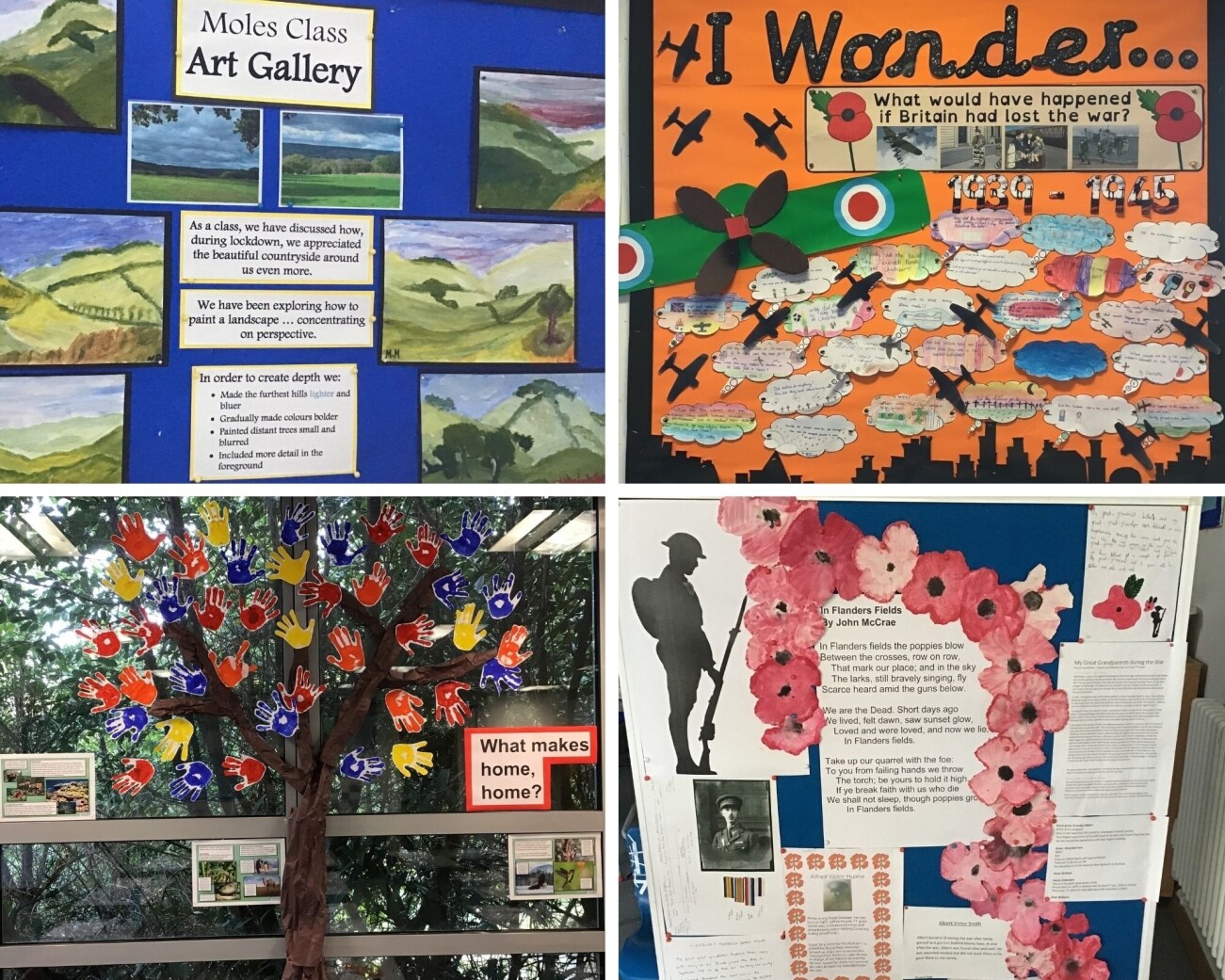
There are opportunities for children to develop a variety of art techniques including observational drawing, working with clay, wood, papier-mâché, paints, pastels, printing materials and fabrics. Art experiences are developed by organising trips to art galleries and inviting artists and sculptors to the school. We also have a focussed ‘Artsweek’ during the year.
The school has a specialist music teacher and there is a good range of musical instruments for the children’s own improvisation, including a set of steel pans. Recorders are taught to Year 2 and Year 3 children are taught the ukulele. There is also opportunity for violin lessons, taught by a music teacher from the Surrey Youth Music and Performing Arts service. We have a school choir who can take part in local music festivals and events.
Many talents and interests are fostered during the early school years at school that may develop into forms of self-expression and achievement, leading towards a future career or hobby.
In line with the school’s policy towards health related fitness, children are given daily opportunities to develop physical skills through games and gymnastic apparatus and creative movement.
We are committed to offering all children the opportunity of engaging in physical exercise for a minimum of three hours a week. All class teachers have been trained in the nationally accredited ‘Top Play’ PE scheme.
By Year 3, the children are taught small team games and inter-school activities are planned for the Year 4 children upwards, where we have access to the Westcott Sports Club as a venue. Throughout the school, athletic skills are taught in the summer term and each child is encouraged to improve his/her performances in aiming, running and jumping. At our Sports Days all children are encouraged not only to perform their best on an individual basis but also as part of a team.
Key Stage 1 and 2 children benefit from participating in sporting events at both The Ashcombe and Priory Schools in Dorking and Junior children take part in the Dorking Schools Indoor Athletics and Swimming Competitions.
We are committed to the teaching of swimming. All children in Years 1, 2,3 and 4 have lessons taken by qualified Instructors, where they work for a series of development badges. Arrangements for lessons will be made for older children who cannot swim 25 metres.
Healthy attitudes toward hygiene, diet, sex, safety and interpersonal relationships are encouraged. The ‘Life Centre’ bus and School Nurse and Dentist are also used to support teaching in these areas.
Sex education in the school is at the discretion of the Governors. Governors have agreed an appropriate policy, which includes topics on ‘Ourselves’ and the life cycles of animals, plants and insects.
Members of staff are sensitive to the differing experience of the children and the views of parents.
A range of different activities are offered to the children during their time at the school.
These will vary from year to year but activities may include:
• Football • Golf, tag-rugby or cricket
• Multi-sports • Dance
• Drama • Choir
• Recorders • French
Yrs 5 and 6 also have the opportunity to take part in a Cycling Proficiency Course.